NOTE 01

Field notes · Plants

CARNIVORES, PARASITES AND GIANTS

Plants cannot run, but some count, some hunt, some steal and some simply outlast everything around them. Here is what the measurements say, and where the stories go too far.

Read the First Field Note
NOTE 02

Why plants turn strange

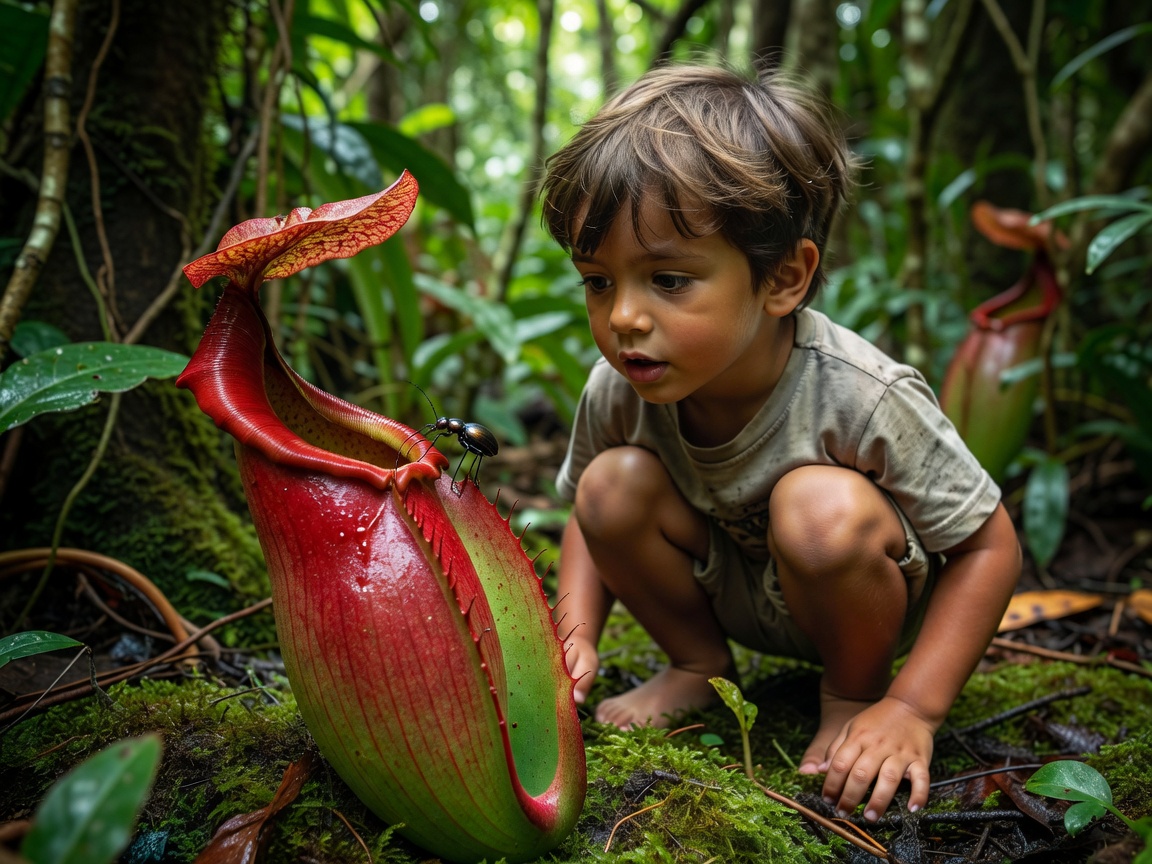
A child kneeling close to a tall pitcher plant in a garden, studying the open lid and the insect resting on its rim
Close observation, no touching: the best way to meet a carnivorous plant.

A plant needs light, water, carbon dioxide and a steady supply of nutrients such as nitrogen and phosphorus. Remove one of these and evolution starts improvising. Carnivorous plants mostly grow in bogs, fens and wet sands where nitrogen is scarce; insects become a fertiliser delivery service.

Parasitic plants took a different shortcut. They tap into other plants' plumbing and take sugar, water or both. Some have given up photosynthesis entirely. Giants and ancients, meanwhile, show what slow growth and patience can achieve when conditions are harsh but stable.

None of these plants have brains or nerves. What looks like behaviour is built from electrical signals, hormones and growth responses. Understanding the mechanism makes the result more impressive, not less.

NOTE 03

Carnivores

  • Venus flytrap Dionaea muscipula

    A Venus flytrap counts. One touch of a trigger hair does nothing; a second touch within about half a minute snaps the trap shut; further touches switch on its digestive glands.

    Each touch fires an electrical signal across the leaf, and researchers measuring those signals in 2016 showed the plant tallies them before committing energy. Counting avoids wasting a closure on a raindrop. In the wild, flytraps grow only in a small area of the Carolinas, centred on the coastal plain around Wilmington, North Carolina, in sunny, fire-maintained wetlands.

    Field note: poaching is a serious threat. Since 2014, taking wild Venus flytraps in North Carolina has been a felony. Nursery-grown plants are widely available.

  • Bornean pitcher plants Nepenthes rajah, N. lowii

    Some giant pitchers are shaped as toilets for tree shrews.

    On Mount Kinabalu and nearby mountains in Borneo, mountain tree shrews perch on these pitchers to lick sweet secretions from the lid. The distance from lid to rim matches the animal's body, so its droppings fall into the pitcher, giving the plant much of its nitrogen. N. rajah pitchers can hold up to around 3.5 litres of fluid and occasionally trap small vertebrates, though insects remain the main catch.

  • Bladderworts Utricularia spp.

    The suction trap of a bladderwort fires in less than a millisecond.

    Tiny underwater bladders pump out water to create low pressure. When a water flea brushes a trigger hair, the trapdoor buckles open and the prey is sucked inside, one of the fastest movements known in plants.

NOTE 04

Parasites

  • Rafflesia arnoldii

    It produces the largest single flower on Earth, up to about a metre across, yet has no leaves, stems or roots.

    For most of its life Rafflesia exists as threads of tissue inside Tetrastigma vines in the rainforests of Sumatra and Borneo. Only the flower breaks out. It smells of rotting meat, attracting carrion flies as pollinators, and lasts just a few days before collapsing.

  • Dodder Cuscuta spp.

    A dodder seedling grows toward the airborne scent of plants it can parasitise.

    In a 2006 experiment, seedlings of Cuscuta pentagona bent toward volatile chemicals released by tomato plants and preferred tomato over wheat. With little chlorophyll, a seedling has only days to find a host before it starves. Once attached, it coils around stems and pushes feeding structures into them.

  • Hydnora africana

    This southern African plant lives almost entirely underground, attached to the roots of succulent euphorbias.

    Its fleshy flower pushes just above the soil, smells of dung and briefly traps beetles inside to ensure pollination before releasing them.

  • Ghost pipe Monotropa uniflora

    A white flowering plant with no chlorophyll at all.

    It feeds on fungi that are connected to the roots of trees, taking carbon that ultimately came from those trees' photosynthesis.

NOTE 05

Giants and ancients

  • Titan arum Amorphophallus titanum

    Its flowering structure can stand around three metres tall and warms itself to spread its smell.

    Native to Sumatra, it blooms only every few years. The central spike heats up during flowering, lifting the scent of carrion higher into the forest air.

  • Welwitschia mirabilis

    It grows just two leaves in its entire life, and some plants are thought to be more than 1,000 years old.

    In the Namib Desert of Namibia and Angola, the two strap-like leaves keep growing from the base while their tips fray, collecting moisture from coastal fog.

  • Pando Populus tremuloides

    Roughly 47,000 aspen stems in Utah are one single organism.

    In Fishlake National Forest, Pando's trunks share one root system across about 43 hectares, making it one of the heaviest living things known. Heavy browsing by deer and cattle now prevents many young stems from surviving.

NOTE 06

Rumour checks

Do plants learn? In a 2014 study, sensitive plants (Mimosa pudica) that were repeatedly dropped stopped folding their leaves, and the effect appeared to last for weeks. Some researchers call this learning; others argue it can be explained by fatigue or simpler responses, and the result has not been widely replicated. Status: interesting, unsettled.

The man-eating tree of Madagascar. In 1874 a newspaper story described a tree that devoured a human sacrifice, attributed to a German explorer named Carl Liche. Neither the tree nor the explorer has ever been shown to exist. Status: hoax, still recirculating.

Next: how to observe without harm