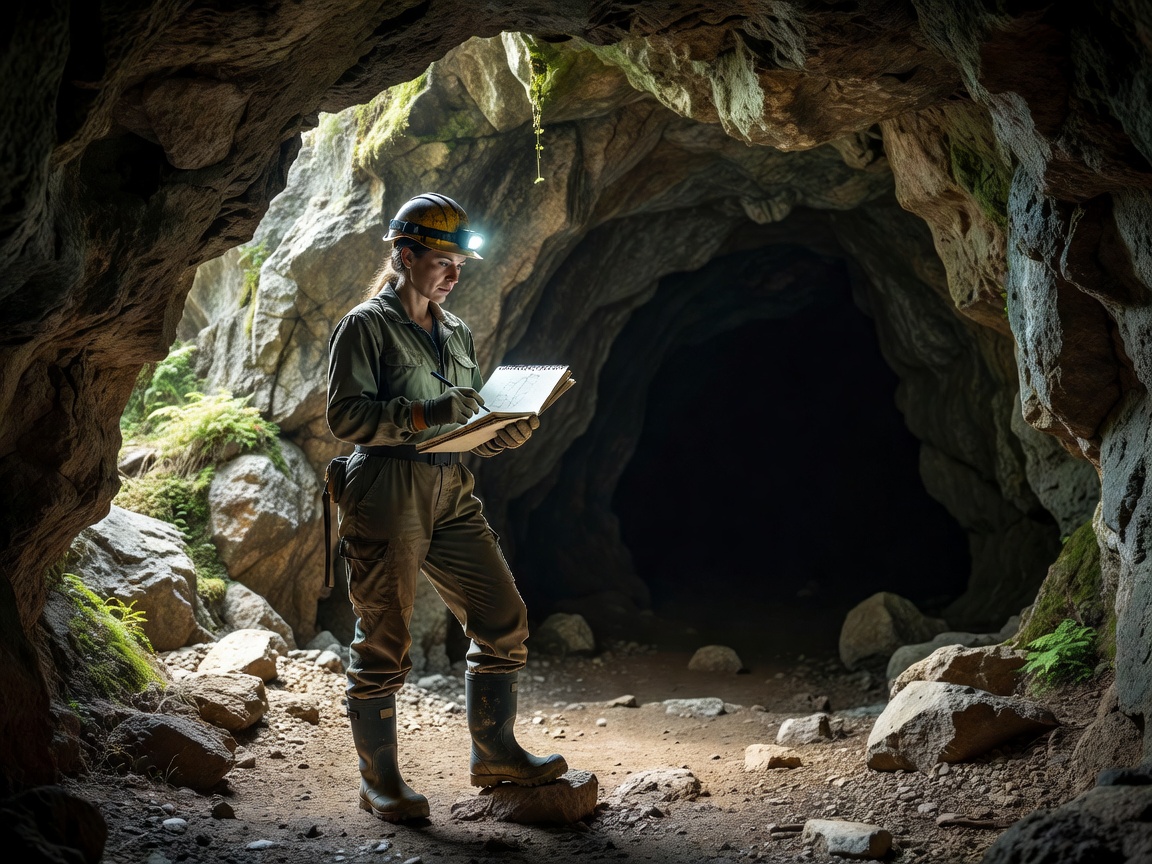
Ecosystems that run on chemistry instead of sunlight, thrive in water that would burn your skin, or have been sealed off from the surface since long before our own genus existed.
Most food webs on Earth begin with photosynthesis: plants and algae capture sunlight, and everything else eats them or eats something that did. For most of the history of biology, that was simply assumed to be how life worked.
In 1977 the research submersible Alvin dived on the Galápagos Rift, about 2,500 metres down, and its crew found dense communities of clams, mussels and tube worms clustered around warm water seeping from the seafloor. No sunlight reaches that depth. The food came from bacteria that harvest energy from chemicals such as hydrogen sulphide, a process called chemosynthesis. It was one of the great surprises of twentieth-century biology.
Since then, researchers have found chemosynthetic and extremophile communities in caves, acid pools, alkaline lakes and salt crusts. These places are not just curiosities. They show how flexible life is, and they guide the search for life on other worlds.
Cave entrances mark the boundary between sunlit and chemical food webs.
NOTE 03
Ecosystem types
Giant tube worm Riftia pachyptila
An adult has no mouth and no gut.
Instead it houses billions of sulphur-oxidising bacteria in an organ called the trophosome. Its bright red plume is coloured by haemoglobin that carries oxygen and sulphide to its microbial partners, which turn them into food. Tubes can grow taller than an adult person.
Lost City hydrothermal field
White carbonate towers, some around 60 metres tall, rise from the Mid-Atlantic seafloor.
Discovered in 2000 on the Atlantis Massif, Lost City vents warm, strongly alkaline fluid rather than the scalding, acidic water of black smokers. Its chemistry, driven by reactions between seawater and mantle rock, is studied as a model for where life may first have begun.
Hadal snailfish
In 2022 a snailfish was filmed at 8,336 metres in the Izu-Ogasawara Trench, the deepest fish yet recorded.
Snailfish have soft, gelatinous bodies and few hard parts, which suits crushing pressure. Below roughly 8,200 metres, physiology may simply stop working for fish.
Movile Cave, Romania
Isolated from the surface for an estimated 5.5 million years.
Found in 1986 near Mangalia during construction work, the cave holds a food web built on bacterial mats floating on sulphidic water. Its air carries roughly half the oxygen of normal air and high levels of carbon dioxide. More than 30 of its invertebrates are known nowhere else. Access is restricted to a handful of researchers.
Cueva de Villa Luz, Mexico
Microbial "snottites" drip from the ceiling with acidity close to battery acid.
Springs in this Tabasco cave release hydrogen sulphide. Bacteria oxidise it into sulphuric acid, forming dripping biofilms. In the streams, a population of shortfin molly fish has adapted to toxic, low-oxygen water.
Lake Natron, Tanzania
Water with a pH around 10 is the most important breeding site for lesser flamingos in East Africa.
Hot springs feed the shallow lake with sodium carbonate. Salt-loving microbes stain it red. Few predators will cross the caustic mud, so flamingos nest on its islands and feed on cyanobacteria.
Salar de Uyuni, Bolivia
At over 10,000 square kilometres, it is the largest salt flat in the world.
Lying about 3,656 metres above sea level, it floods into a mirror in the wet season. Nearby lagoons such as Laguna Colorada host Andean, Chilean and the rarer James's flamingos.
Dallol, Ethiopia
Some pools here have a pH below zero.
In the Danakil Depression, hot, hypersaline, hyperacid springs paint the ground yellow and green. A 2019 study found no active life in the most extreme pools, a useful limit for astrobiology. Earlier claims of microbes there remain debated.
Socotra, Yemen
Around a third of its plant species grow nowhere else.
The umbrella-shaped dragon's blood tree, Dracaena cinnabari, catches mist with its crown and shades its own roots. Long isolation in the Arabian Sea produced an island flora unlike any other.
Ball's Pyramid, Australia
In 2001, 24 Lord Howe Island stick insects were found under a single shrub on a bare sea stack.
Thought extinct after rats reached Lord Howe Island in 1918, the insect survived on this volcanic spire 23 kilometres away. A captive breeding programme now supports its return.
NOTE 04
Habitat table
Approximate figures from published surveys. Depth is below sea level unless marked as elevation.
Location
Depth / elevation
Conditions
Galápagos Rift vents, eastern Pacific
~2,500 m depth
Warm vent water in near-freezing sea, no sunlight, chemosynthesis
East Pacific Rise black smokers
~2,600 m depth
Vent fluid around 350 °C, mineral-rich, acidic
Lost City, Mid-Atlantic Ridge
~750 m depth
Alkaline fluid (pH 9–11), carbonate towers up to ~60 m
Izu-Ogasawara Trench, western Pacific
8,336 m (deepest fish filmed)
Pressure over 800 times surface level, near-freezing
Movile Cave, Romania
~20 m below ground
Sealed for ~5.5 million years, low oxygen, sulphidic water
Cueva de Villa Luz, Mexico
Shallow cave system
Hydrogen sulphide springs, strongly acidic biofilms
Lake Natron, Tanzania
Under ~3 m deep; ~600 m elevation
pH around 10, shallow water up to ~60 °C
Salar de Uyuni, Bolivia
~3,656 m elevation
Salt crust, intense UV, freezing nights
Dallol, Ethiopia
~125 m below sea level
Hyperacid, hypersaline, hot; toxic gases
NOTE 05
Fact versus rumour at the lakeshore
Lake Natron is famous online as the lake that "turns animals to stone". The source is a striking photo series published in 2013 by photographer Nick Brandt, showing birds and bats encrusted in mineral deposits. Brandt explained that he found the animals dead along the shore and posed them for the images.
The ecology is real but slower and less dramatic: sodium carbonate in the water can preserve carcasses and coat them in salts as they dry. Animals are not petrified on contact. The more astonishing fact is the reverse one: millions of flamingos raise their chicks in this caustic water every breeding season.
Places like Dallol carry a similar warning in the other direction. They look alive with colour, but the colours come from minerals, not microbes. Measured, repeated sampling is what separates the two.
NOTE 06
Next field note
From habitats to the plants that adapted to them, some by eating insects, some by stealing from their neighbours. Continue to the plants
Your privacy choices
Essential cookies keep this site working. Optional ones help us see what is useful. You can change your choice at any time. Cookie policy